
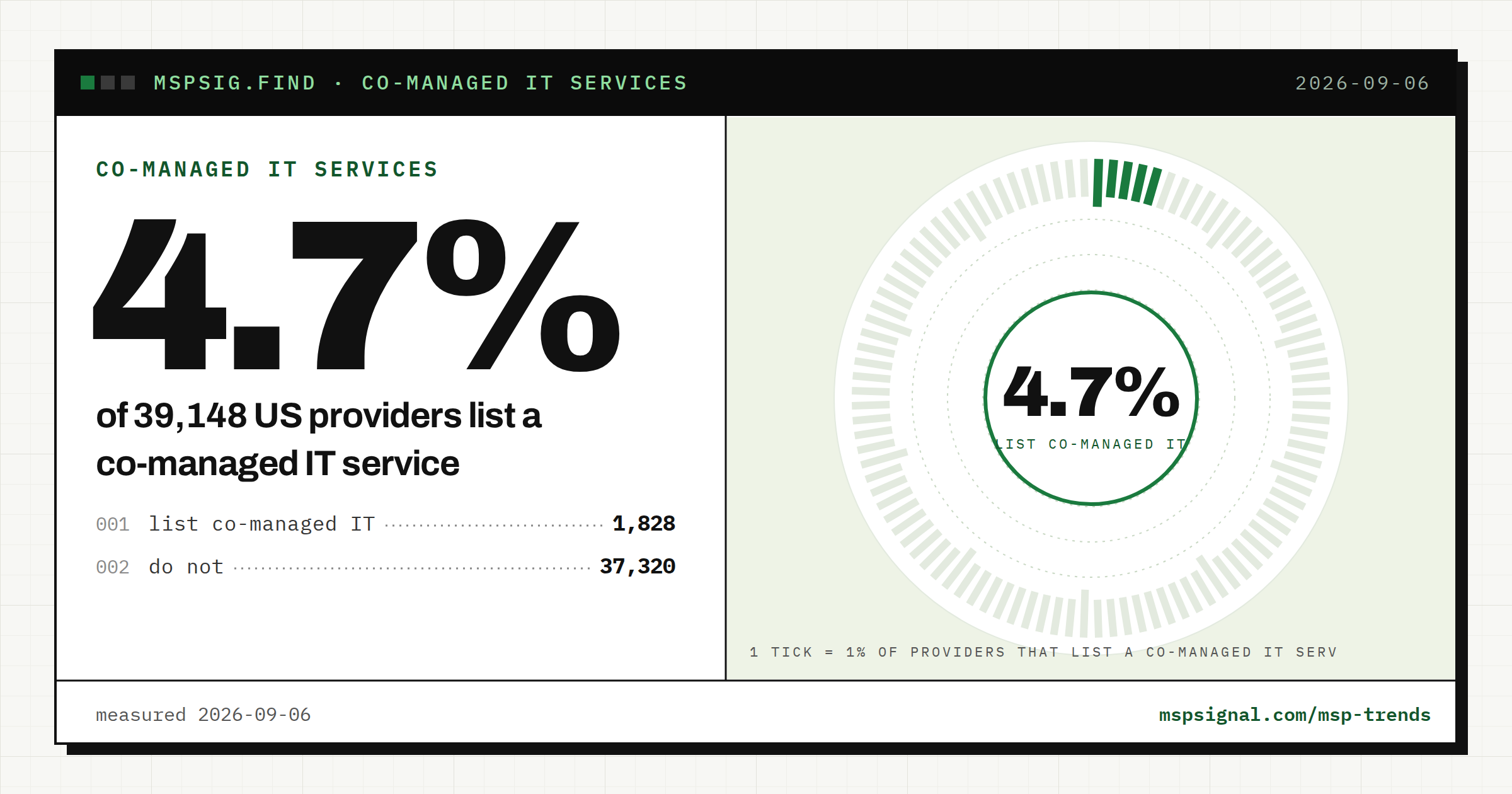
Headline finding · measured 2026-09-06
1 in 21 US providers offers co-managed IT, and those firms outscore the market on every signal we track.
Co-managed IT means a provider working alongside your in-house team rather than replacing it. Who offers it, how they differ from the rest of the market, and what they charge.
5% list co-managed IT (1,828)do not (37,320)
Co-managed (1,828 firms)
- Show a certification
- 41.1%
- State 24/7 coverage
- 29.5%
- Median Google reviews
- 14
- Median MSP Signal score
- 57
All providers (39,148)
- Show a certification
- 15.4%
- State 24/7 coverage
- 13.1%
- Median Google reviews
- 4
- Median MSP Signal score
- 41
1-10 staff44.5 %
11-50 staff38.1 %
51-200 staff9.6 %
201+ staff2.9 %
No headcount on file4.9 %
Measured across 39,148 in-scope US providers in one snapshot; unknowns count against every share. 1,828 list a co-managed service; comparisons are against all 39,148 unless stated. as of 2026-09-06.
Limitations
- This card was measured on 2026-09-06 at a base of 39,148 in-scope US providers in one repeatable-read snapshot. The rest of this edition is frozen at 39,351 from 2026-09-03; cleanup moved the base by 0.5% between snapshots. Every figure here is quoted against 39,148, and no existing card was rebased.
- 'Lists co-managed' matches co-managed or comanaged in a firm's listed services. 1,893 is the count when the firm's own description is included as well. Firms that sell the model under another name (supplemental IT, augmented IT, IT partnership) are not counted.
- Services are readable for 32,354 of 39,148 firms; the 4.7% headline counts the other 6,794 as not offering co-managed IT. 5.7% is the share among firms whose services we can read.
- MSP Signal score is our own 0-100 composite (reputation 30%, digital presence 25%, credibility 20%, scale 15%, momentum 10%). A higher median for the co-managed group describes the firms, not the quality of any specific contract.
- Pricing uses only rows with unit per user, period month, a current snapshot and an amount between $10 and $500, each firm counted once at its cheapest tier: 65 co-managed firms against 361 overall. Advertised rates, not contracts, and co-managed work is frequently not priced per user.
- The 'shows pricing' shares (2.3% and 0.8%) come from a site-level flag and are a different, stricter signal than the pricing table.
- Headcount is on file for 1,739 of the 1,828 co-managed firms and 29,505 of 39,148 overall; medians describe the firms we can see.
What to do with this
- Buying: if you already employ IT staff, ask every provider on your shortlist whether they do co-managed work. 95.3% will not have said so on their site, and the ones that do are, on average, the more credentialed firms in your market.
- Selling: co-managed providers show a certification at 2.7 times the market rate and state 24/7 coverage at 2.3 times it. If you offer the model, the credentials are the proof buyers with in-house teams look for first. Publish them next to the offer.
Cite this
MSP Signal, "1 in 21 US providers offers co-managed IT, and those firms outscore the market on every signal we track.", measured 2026-09-06. https://mspsignal.com/msp-trends/co-managed-it-services
More findings
7.7%Under 8% of MSPs let you book time online, and only 1% offer live chat.9The median US MSP has 9 employees. 37% of the market is under 10.12%12% of MSPs with a known founding year were founded in the last six years.86%86% of MSPs show no certification at all.
◂ All 93 findings