
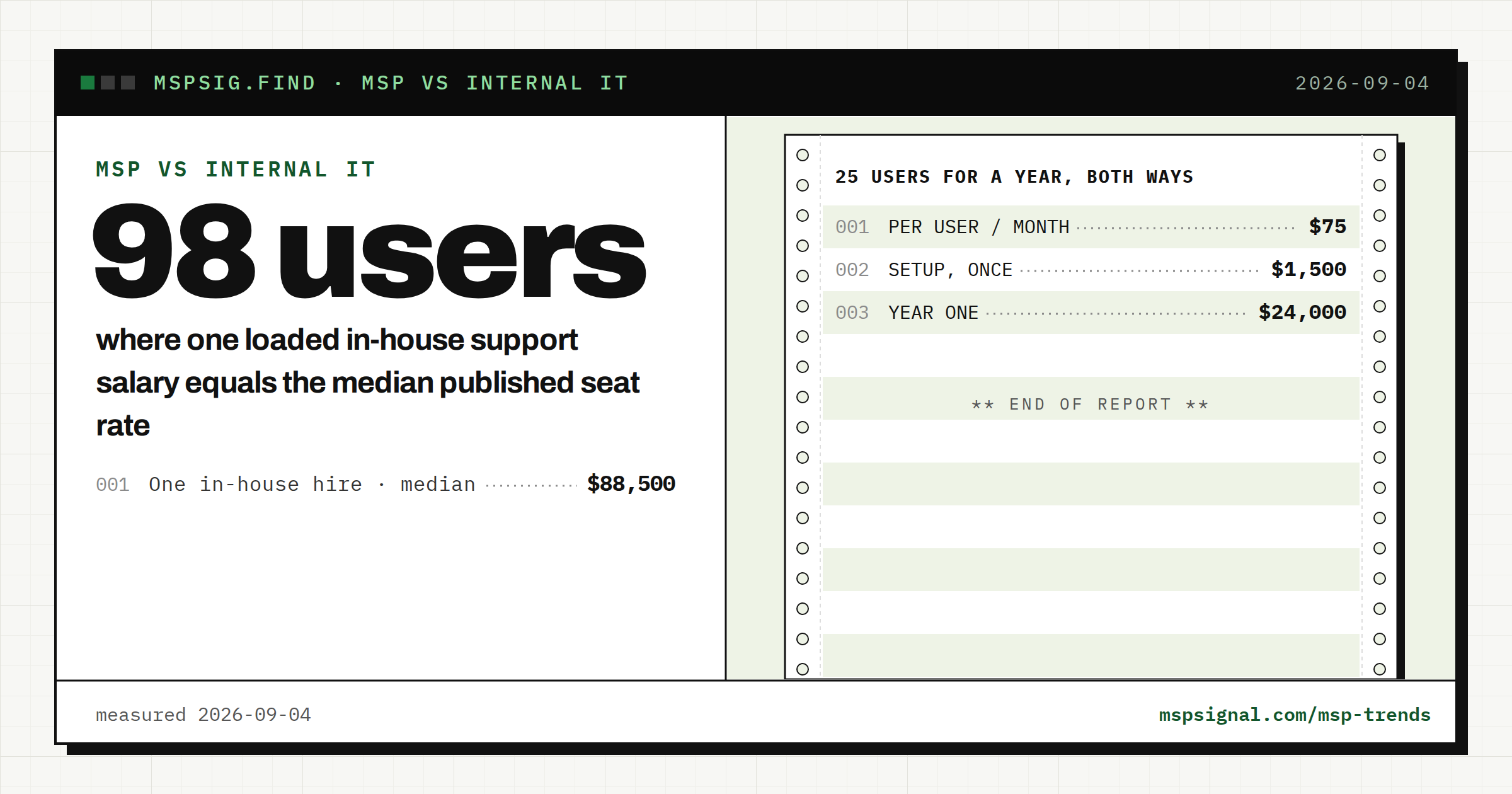
Headline finding · measured 2026-09-04
One in-house IT hire costs what managed IT costs for about 98 users.
Both sides of the decision, priced: our own measurement of what US providers publish, against the federal median wage for the person you would otherwise hire.
Managed service
median published entry rate, 367 firms
- Per user / month
- $75
- Setup, once
- $1,500
- Year one
- $24,000
One in-house hire
BLS median wage, loaded at 30.1% benefits
- Support specialist
- $88,500
- Sysadmin
- $141,800
- Hours of the year covered
- 24%
Support hire vs $75 seat98 users
Support hire vs $99 seat75 users
Sysadmin vs $75 seat158 users
Sysadmin vs $99 seat119 users
14% state 24/7 coverage (5,316)show us no 24/7 claim (34,056)
MSP side: 367 of 39,372 in-scope US providers publish a per-user, per-month rate; the median entry tier is $75. In-house side: BLS Occupational Outlook Handbook median annual wages for May 2025, loaded using the BLS Employer Costs for Employee Compensation share for March 2026, benefits are 30.1% of total compensation for private-industry workers, so wages are 69.9% of it. as of 2026-09-04.
Limitations
- This card was measured on 2026-09-04 at a base of 39,372 in-scope US providers. The rest of this edition is frozen at 39,351 from 2026-09-03; a routine intake of 21 firms moved the base by 0.05% between snapshots. Every MSP-side figure here is quoted against 39,372, and no existing card was rebased.
- The in-house side is a cited external benchmark, not our measurement. Wages are BLS Occupational Outlook Handbook medians for May 2025. The 30.1% benefits share is BLS Employer Costs for Employee Compensation for March 2026, measured across all private-industry occupations rather than IT specifically.
- Loaded cost is the wage divided by 0.699. It covers benefits as BLS defines them. It excludes recruiting, a workstation, software licenses, training and management time, all of which fall on the in-house side only.
- The MSP side is an advertised entry rate, not a contract. The entry tier is each firm's cheapest published per-user, per-month rate, and a quote for a real environment usually lands above it.
- The break-even is arithmetic on two medians drawn from two different populations. No company was observed paying either number.
- 13.5% stating 24/7 coverage is a floor: hours are checked on 19,917 of 39,372 firms and an unchecked firm counts as showing nothing.
- Headcount is on file for 29,744 of 39,372 firms. The median of 9 describes the firms we can see, not the 9,628 we cannot.
What to do with this
- Buying: work out your own break-even before the first call. Loaded salary divided by twelve times the per-user rate is the whole calculation, and at the published medians it lands between 75 and 98 users.
- Selling: the comparison your prospect is running is against about $88,500 a year of salary, not against another provider. Price the coverage gap, 2,080 hours against 8,760, rather than the seat rate.
Cite this
MSP Signal, "One in-house IT hire costs what managed IT costs for about 98 users.", measured 2026-09-04. https://mspsignal.com/msp-trends/msp-vs-internal-it
More findings
9 staffThe median US IT support provider has 9 employees, and 85% serve a single local market.4.7%1 in 21 US providers offers co-managed IT, and those firms outscore the market on every signal we track.7.7%Under 8% of MSPs let you book time online, and only 1% offer live chat.9The median US MSP has 9 employees. 37% of the market is under 10.
◂ All 98 findings