
Published 2026-09-24 · updated 2026-10-06
IT Companies in Texas: What the National Directory Data Shows
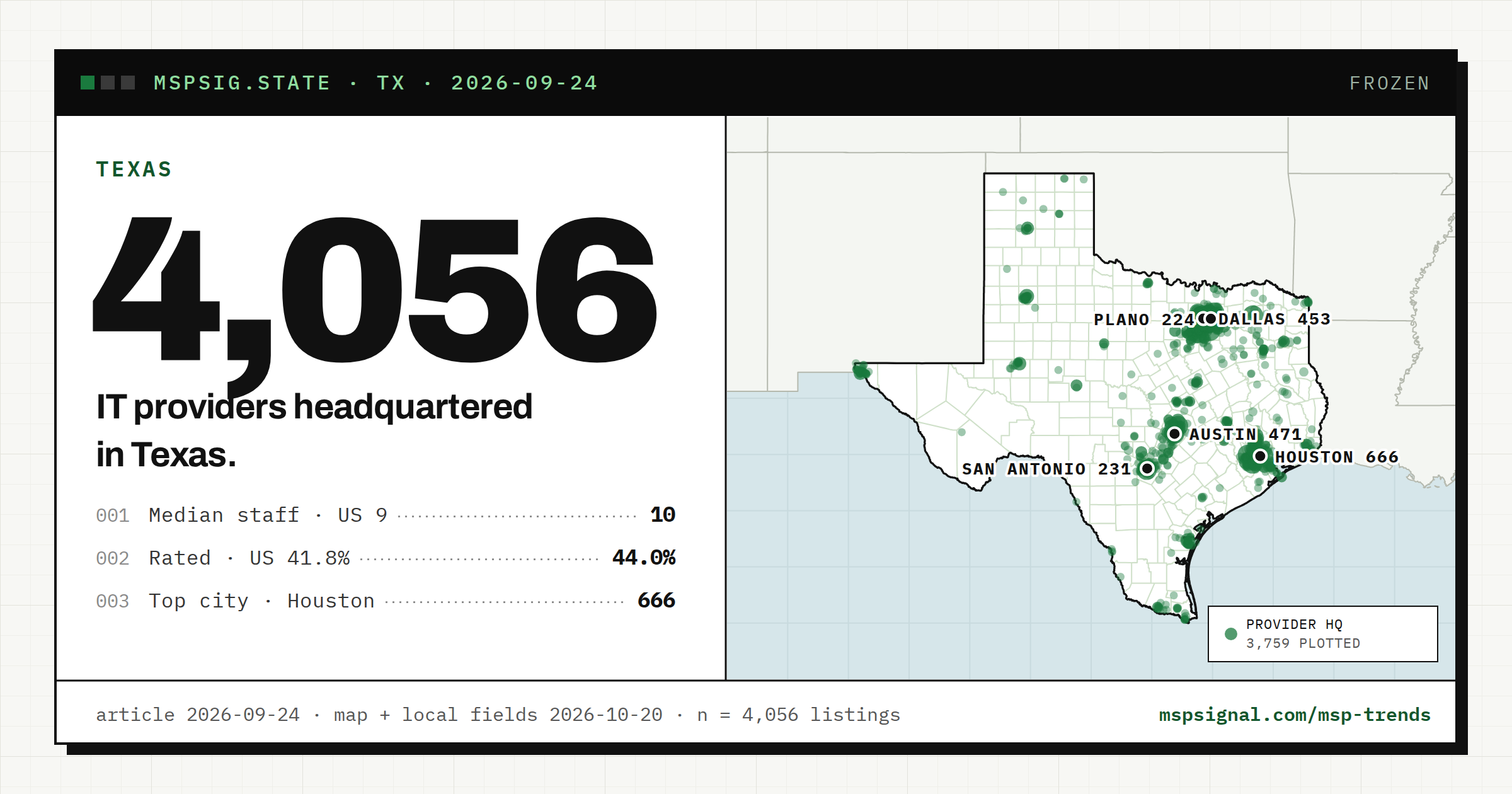
National directory data places Texas among the top states for IT service provider listings, with patterns in ratings, size, and pricing transparency that hold across the full dataset.
The live directory
This article is a frozen measurement. The directory page for Texas is live and re-ranked continuously.
Browse providers in Texas ▸| Measure | Texas | United States | Comparison |
|---|---|---|---|
| Listed providers | 4,056 | 43,995 | 9.2% of US |
| Median staff | 10 | 9 | Larger |
| Have a Google rating | 44.0% | 41.8% | Above |
| # | City | Providers | Count | % of state |
|---|---|---|---|---|
| 01 | Houston | 666 | 16.4% | |
| 02 | Austin | 471 | 11.6% | |
| 03 | Dallas | 453 | 11.2% | |
| 04 | San Antonio | 231 | 5.7% | |
| 05 | Plano | 224 | 5.5% | |
| 06 | Irving | 159 | 3.9% | |
| 07 | Frisco | 148 | 3.6% | |
| 08 | McKinney | 68 | 1.7% |
Texas shows up as one of the most represented states in a national directory of IT service providers, ranking among the top five states alongside California, Florida, Virginia, and New York. This places Texas in a small group of states that account for a disproportionate share of the listings tracked across the country.
The full dataset behind this ranking includes roughly 40,000 published IT service provider profiles, spanning all 50 states. That geographic spread means the directory captures activity well beyond the largest tech hubs, but the concentration of listings in a handful of states, Texas included, suggests that provider density still tracks closely with population and business activity in those regions.
Across the national dataset, 18,399 profiles carry a Google rating. Where ratings exist, the median rating sits at 5.00. This is a notable pattern: it means that for providers with any public rating data at all, the midpoint of that distribution is a perfect score. It does not mean every provider is rated identically, but it does indicate that median outcomes cluster at the top end of the scale rather than somewhere in the middle. For anyone searching for IT companies in Texas or any other state, this national pattern is useful context: a five-star median is common across the industry, not a distinguishing feature of any single market.
Pricing transparency is far less common. Only 298 profiles in the entire dataset include published pricing information. Out of roughly 40,000 total listings, that is a small fraction, which means most research into IT service providers, in Texas or elsewhere, will not turn up public pricing details. Buyers relying on directory data alone should expect to request quotes directly rather than compare published rates.
Size data offers another angle on the market. The median number of employees across all listed providers is 9.0. This points to a landscape dominated by small teams rather than large firms. A provider with roughly nine employees represents the midpoint of the distribution, meaning half of all listed providers are smaller than that and half are larger. This is a useful benchmark for anyone trying to understand what a "typical" IT service provider looks like in terms of staffing, whether the search is national or focused on a single state like Texas.
Activity signals also matter for understanding how current this data is. Over the past 30 days, the dataset recorded 12,577 signals. This is a measure of ongoing activity across the tracked providers, and it indicates that the directory is not a static snapshot but reflects a dataset with regular updates and engagement.
The state-level ranking is the most granular geographic signal available here, and Texas's position in the top five states is the clearest data point specific to the state.
Taken together, the numbers describe a national market where a small number of states, including Texas, host a large share of listed IT service providers. Within that market, ratings skew high at the median, pricing disclosure is rare, and the typical provider is a small team of around nine employees. These patterns apply broadly across the dataset and are not unique to any single state, but they help frame what a Texas-focused search is actually likely to find when it comes to provider size, rating behavior, and pricing visibility.
Correction (October 5, 2026): an earlier version of this article said the directory covered 0 metro areas. That figure came from a faulty query. The directory maps providers to 756 metro areas.
Correction (October 5, 2026): an earlier version of this article gave the directory size as 40,184. That figure was a display floor, not a measured count. The directory held roughly 40,000 providers on this date.
How each number was measured (7)
- Top States
- CA, TX, FL, VA, NY
- Signals 30d
- 12,577
- With Pricing
- 298
- Median Rating
- 5.00
- States Covered
- 54
- Median Employees
- 9
- With Google Rating
- 18,399
Cite this
MSP Signal, "IT Companies in Texas: What the National Directory Data Shows", measured 2026-10-06. https://mspsignal.com/msp-trends/it-companies-in-texas-national-directory-data